
It’s a rainy November Saturday. My husband and I decided to spend part of the morning sharing what we were watching or listening to. I shared a podcast episode from the Ezra Klein show. The web page describes the episode thus:
“This is a conversation about the relationship between Jewishness and the Jewish State. About believing some aspects of Israel have become indefensible and also believing that Israel itself must be defended. About what it means when a religion built on the lessons of exile creates a state that inflicts exile on others. About the ugly, recurrent reality of antisemitism.”
I have listened to this twice now. Ezra Klein interviews Rabbi Sharon Brous regarding her September 25, 2023 sermon, which predates the horrors of the current war in Israel and Palestine, by a matter of days. In the interview, she explains how what we think we know is based more on our own experience than on any continuing solid fact, how American Jews are keenly feeling their kinship to Israeli Jews, how antisemitism has touched them in places they had previously felt were safe.
And for her, as for me, comes the uncomfortable awareness that the ancient scriptures say to love your neighbour. For a people whose religion is founded on the story of exile to be exiling and harming those very neighbours … well, as she says, right now they are grieving. Right now they are terrified. But that does not negate the foundations of their faith; it only highlights the ethics, the paradox, the hard hard questions.
After that, we watched a video about the James Webb telescope, and how the newest views of Deep Space question the idea of the Big Bang, because the telescope has found galaxies and star systems that were fully formed far too soon. This, the video says, is like looking at a photo of someone you know should have been a baby at the time of the photo, only to learn that person was already adult when the photo was taken.
Our ideas of what the universe looks like have changed so much since Einstein. Now, for most of us, what we learned since then feels like fact, rather than theory. But, again, what we think we know to be true may not be true at all.
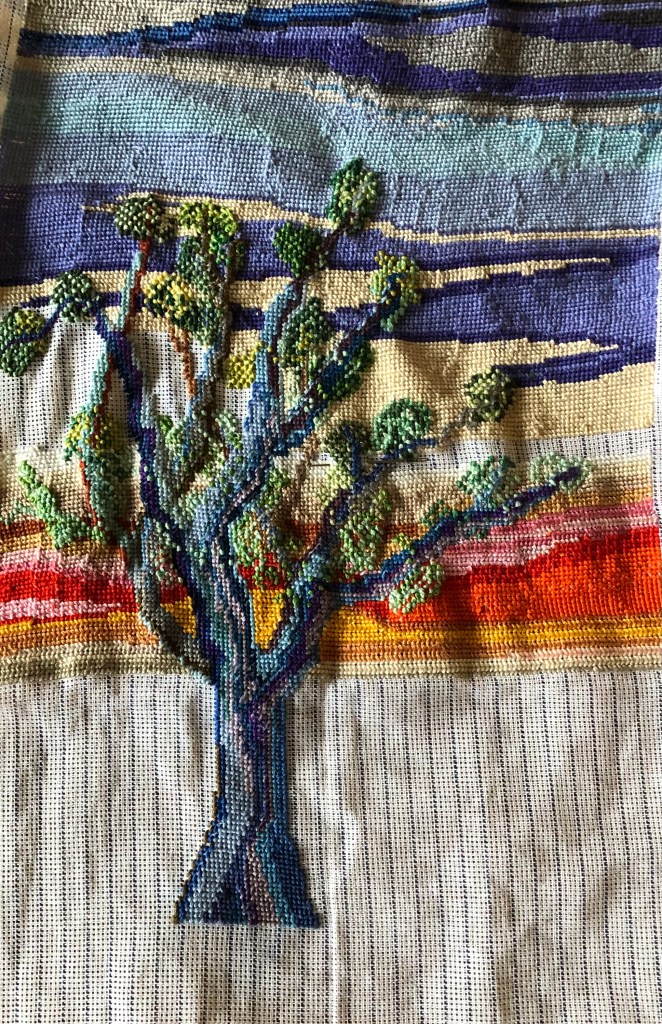
As we watched and listened, I was stitching on a project I’ve be working on for a year. I have inherited yarns, embroidery floss, aida cloth, and hoops of all sizes. Wanting a tiny portable project, I dug into my supplies, and began a freestyle piece based on what I found there, with no pattern beyond the developing picture in my imagination. By spring, the tree was complete, and strand by strand, the morning sun brightened the sky into dawn.
I have long used craft work to focus my mind — embroidering through high school classes and irritating university professors with the click click of my knitting needles. One day this spring, I was stitching away at a meeting, when a woman commented that I was using “waste canvas.” Pardon me? What did you say?
Waste canvas, she explained, is used when one wants to cross stitch onto regular fabric. You stitch through both the canvas and the garment, for example, and then remove the waste canvas by washing the item. “If you wash that,” she said, pointing to my beautiful creation, “all that will be left will be a tangle of string!”
She knew it was Waste Canvas because of the blue lines. I hadn’t cared about the blue counting lines because I planned to cover every inch with colour. No blue would show. I’d never heard of “waste” canvas. My heart sank. I was faced with the choice of tossing the whole thing, or continuing, knowing what I now knew. Since then I have been vigilant, protective of this vulnerable piece of art.
Today, as I listened and stitched, I thought about how so many things we think are true just aren’t. Rabbi Brous expresses the conflict I too feel about Israel becoming the oppressor, but she holds a depth of historical trauma that I will never experience. Potato famine is nothing by comparison. I listened and stitched, and felt these words rising. What else in my world is not as I believed? What “truths” are morphing into new realizations with each new day?
From a war on the other side of the world, to the far distant beginnings of the Universe, so many things become other than we expected when we look more closely. And so it is, regarding Waste Canvas. Turns out, the woven strings of the canvas don’t actually dissolve. The warp and woof of the material is made sturdy by a dissolvable glue. Once wet, the strings can be pulled away with tweezers, an exacting and exhausting task.
There’s no way that my piece will become a tangle of colourful thread. The glue may be gone, but the stitches are so dense that nothing could pull it apart. At least that’s the story as I understand it now. But with reality tending to dissolve on closer inspection, one never knows for sure.
 Dream Bringer’s Studio
One thought on “James Webb, Palestine, “Waste Canvas”, and What We Think We Know”