Candles that won’t light are the bane of any worship leader, even when the worship is solitary, at home, for online services or private prayer. I’ve written about my necessary careful tending of the Peace candle. Then this morning, my fire would not start. I kept adding paper, kindling, but only achieved smouldering and smoke. Finally, sitting with the stove door open, I managed for it to catch. Only later did I realize the damper had been closed for the night. I’d forgotten to check.
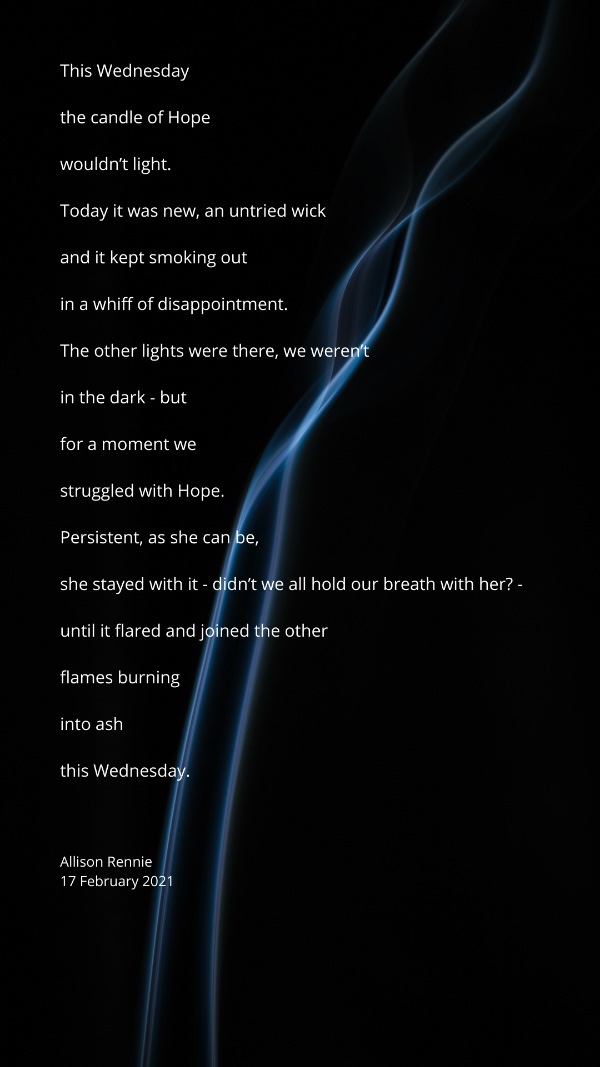
Not enough air. Not enough breath. Not enough Spirit sometimes in our lives, to light the flame of hope or peace or love. Persistence, writes Allison. Staying with it. Let’s not give up on our world. Thanks, Allison!
Today’s sermon is about Love, not the usual kind of love that we celebrate on Valentine’s Day. Today you will hear about Elijah and Elisha, the strength of Elisha’s love for his mentor, and Elisha’s courageous determination not to look away from Elijah even at the moment of his death.
I was not at the side of either of my parents when they died. Daddy’s death was sudden, and I was away. Mom died more slowly, in hospital, and I had to be home. I had to be a mom, and I had to work. Self-employment does not give time off for hospital vigils. So I wasn’t there. I wish I was. I was there in spirit. I was there in dreams. But I was not at my mother’s side. In these Covid times, people around the world have not been there with their dying loved ones. My heart aches for them. My heart aches for those of YOU who have had to wait outside of hospitals in these last 11 months.
Elijah told Elisha that he would go on, to his death, alone, but Elisha refused. He went every step of the way at Elijah’s side. He did not take his eyes off his master, and witnessed the moment when his spirit left his body, like a burning chariot and fiery horses. He tore his clothes in his grief, but he did not turn away.
Our attention capacity is short. We are always blinking, looking away, getting distracted, in normal every day circumstances. In the tough times, keeping our gaze turned toward the pain is hard, almost impossible. At other times, we feel like we can’t pull our attention away at all, from the news of what is happening in the world around us. But being “glued to the screen” is itself a way of NOT seeing what is happening beside us. That pain beside us begs for our attention.
We are learning to be a 21st century church, I’ve said. We are learning to become something different than we have been. In fact, we are being forced to be different, against our wills. We don’t like change, not at all. As I say in today’s sermon, we prefer to look back at the past, than to look squarely into the changes that are coming.
Just like the “Sons of the Prophets” in Elijah’s time were facing a change of era, so are we. Do we watch from a distance like most of them? Or do we walk into it, courageously, like Elisha? I do hope that we get back into our churches for in-person services soon, but what is “soon”? And how long will it take for our services to be “normal”? Will they EVER be “normal”?
I’ve come to realize that we have three congregations in Prince William Pastoral Charge – Living Waters, the Kirk, AND our online congregation. The online folks, some of them never come to church. Some live elsewhere. Some would love to be with us in person, but health concerns or disabilities keep them away. These people tell me how grateful they are for the recorded services. No matter when we get back to seeing each other face to face, we must not abandon these people. This Covid Journey is making us rethink what church is, what church membership is.
For a long time, we have been saying that Church is not a building. The question becomes, can church be ONLY online? Can we do without buildings completely? No, we cannot do without buildings. We need to be able to gather in person. Real change happens in person. Real love happens in person. But the buildings do not have to be church buildings. The buildings may be our homes.That is where Church started, after all, in the homes of believers in communities everywhere, supported by ministers like Paul and Silas, who travelled and wrote letters.
We CANNOT be Church ONLY online, because online it is too easy to look away. I get an email, for example, about the children starving in Yemen. I can delete that, and forget it. I see post after post on Facebook or elsewhere, of people in pain, and I can scroll right past. Or click the “care” button to send a hug, or the “sad” button to express my concern, but this leaves that individual alone, while the Facebook post disappears into the depths of the feed, and my attention is caught by the next meme, or the next funny video.
Real change, real concern, does not happen online. We need to be face to face, loving, caring, helping, supporting. We need to be face to face looking each other in the eye, not turning away from the pain. That is what Church is. No matter what happens with Covid, no matter what happens with our ability to sustain our buildings, we need to keep on loving, keep on being devoted to each other, just like Elisha was devoted to Elijah.
I’m writing this early on Saturday morning. It’s not quite 6 am. I did not expect to write paragraphs; my sermon was already a longish one. Thank you for reading all this. Thank you for not looking away.
I like things to be in order. I like cupboard doors closed, books arranged so they are easy to find when needed, my grocery list arranged in the same order as the aisles in the store. I’m not obsessive about these things, but order, having things and activities in order, my order, keeps my stress level low.
At the same time, whenever life gets more haphazard, so does my space. I have said that the number of papers and assorted odds and ends on my kitchen table act as a useful gauge of my stress level. The same goes for the number of emails sitting in my inbox, or the number of open pages in my browser. The other day I counted 208 emails and 13 windows. Not bad, really, but this feels like having 221 things on my to do list. Two hundred and twenty-one loose ends.
Loose ends take up precious room in my mind. Loose ends gobble up time too, as I spin in thought, trying to decide what is most urgent to get done, or all the smaller steps that are linked to the bigger task.
Do I really want to fix the leaky faucet? Is it better to be annoyed by a leak? Or to brave a trip to the hardware store in Covid? (And with my history, leaky faucets tend to mean more than one visit to the hardware store.)
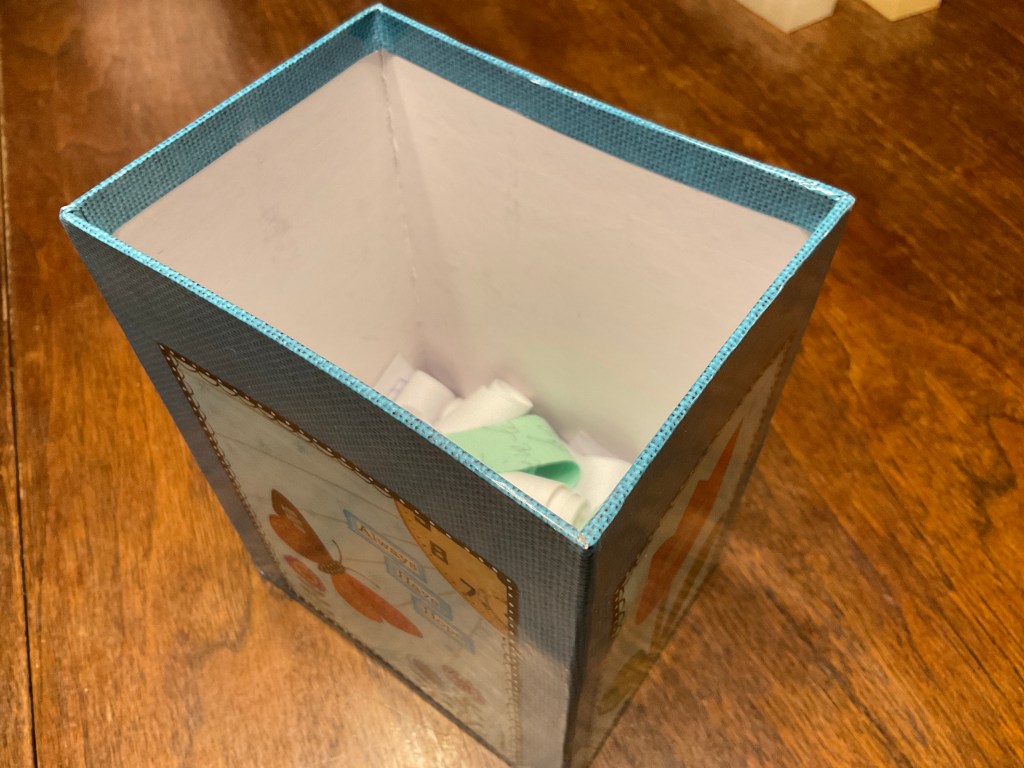
Box of Loose Ends
So here’s what I’ve decided to do: I am going to catch as many loose ends as I can catch, by listing them on slips of paper, dropping them into a pretty box, and then making a Lenten practice out of randomly drawing tasks to complete.
I have started gathering loose ends, writing them down on slips of paper, curling them into twists with scissors, and tucking them into my Loose Ends box. Some loose ends, like dust, are never finished. Some will eventually get done, like the leaky faucet I mentioned the other day. Other loose ends went officially to my “today” list. It’s amazing how much I accomplish once I commit. Since I committed to this Loose Ends practice, many things have shifted, just because of the decision to begin.
I whittled the contents of my inbox, from 208 emails down to 38. I deleted a few, but moved many into a new file named “Loose Ends”. What is left in my inbox are emails about upcoming zoom meetings, and current items for action. Just doing that made me feel more relaxed and spacious.
I also determined that some things do not need to be completed; not all books need to be read. Sometimes one chapter is enough. I can send unfinished books back to the library, or pack them up for the church yard sale. It is a relief to let them go.
I have an ongoing list where every book I’ve read and released in recent years is recorded. I started that practice 40 years ago, when most books I read were from the library. I know I haven’t caught all the titles, but it’s fun to compare what I read in 1981 to what I’m reading now.
It’s harder with books that I love, that belonged to my parents, or that were given to me from the bookshelves of people I respect and appreciate. Marie Kondo says to decide what books to keep based on how you feel when you touch them and look at them. Does the book give you pleasure just by its presence? Don’t decide by opening the book, she insists. Um, no. I’m not there yet.
Deciding what to keep, what to toss, what to pass on to others is now one of the curled up slips of paper in my Box of Loose Ends. But already three boxes of books are gone or ready to go. It’s like a breath of fresh air, like opening a window on the first springlike day. I’ve even dusted a bit, lol!
I woke this morning at 3:30 am. I am an early to bed, early rise, sort of person, but 3:30 is ridiculous. My first thought was that sleep time is boring; I’d rather be up and reading with coffee. Sleep is much more fun if there are dreams, and my dreams have been sparse.
I pulled my nite hood back down over my eyes, and watched the blur on the back of my eyelids for a moment. Soon it was 5 am, and I had a dream! A tiny dream that was not very exciting, but here I am, about to tell you about it.
I dreamed about a wooden box. In the dream, I had seen an ad about this box. It was a cube, maybe 14 inches square. But in my living dream experience, it was much taller, maybe twice as tall or more. I kept checking the ad, and looking at the “real” box. I was confused in the dream, by the difference. It was a box that I had to construct myself, one of those self-assembly jobs, but an easy one. The cover would sit snuggly into place, but I stood with it in my hand, as I weighed the difference between experience and expectation.
Sometimes the most powerful dreams are tiny like this. The fact that I remembered it at all made it important, when I’ve not recorded many dreams for ages. My first thought was that maybe I don’t need dreams, that I live in a larger waking dream than anything I might catch in the night. I reminded myself to continue to pay attention to the symbols and metaphors all around me, all the time. If we carefully watch our waking life, we don’t need to process it so much in the night.
But I did not want to dismiss the dream without thinking about it further. Boxes, boxed in, limitations. I was not boxed in, in this dream. I was outside of the box. I was the one MAKING the box, and feeling the surprise that the box was bigger than expected. If boxes are limitations, then my limitations, limitations of my own making, are less restrictive than I was led to believe by “advertising.”
I was encouraged by the notion of being outside the box. That’s me, in many ways. I am not boxed in at all, and I think outside the box. The boxes I construct are more roomy than people expect. But I still make boxes. We all do. It’s scary to be without limits. What if we all lived outside the box? How would we contain ourselves? Lol! Would our imaginations run wild? Would our emotions be out of control?
I think about how often I try to box up my difficult emotions, and how I tend to jam the lid on them. I do this less now. I used to do it with food, and I no longer use the lid of overeating to squash and bury emotions like I used to. But I still have other lids – a game of solitaire, a tv show, facebook… The list goes on, all the ways I can box up what I do not want to look at.
I have been practising meditation more lately. If I catch myself trying to box stuff up, I sit with it, look at it, release it. I don’t hang onto it, whatever “it” is. (Remember, I am not always successful at this, but I’m getting better at it.)
Maybe by putting fewer things in my “box”, and by keeping the lid off, I am making more space inside of myself. My interior world is more spacious because I am not hoarding so many hurts, worries, or negative belief systems.




 Dream Bringer’s Studio