
Last night, on the edge of sleep, I had the thought, or realization, that I do not any longer need to babysit Carol. I’ve told the story of my childhood memories of Carol many times, most recently while sitting with my husband’s relatives after his father’s death. I was wondering if any of them remembered her. Still it surprised me when that thought woke me last night, with a sensation of falling into freedom. Each time I started to drift off, this same sensation of falling into freedom thrilled me into wakefulness, joy, and expansiveness.
It felt like an invitation to follow my own path in my own time, at last. What child of 8 or 9 is expected to babysit an adult? Actually, it happens far too often, that children parent their parents, but not as many children end up parenting their adult neighbours. My small self must have continued to feel responsible for her, in some way, and responsible for others, too, such that I have spent a good part of my life trying to follow other people’s timing and other people’s paths, instead of my own.
Here is the story of Carol. When I was little, Carol and her husband, Gilbert, moved here as part of the influx of people “from away” working on the construction of Mactaquac Dam. They lived across the road from us, in the old house where my grandmother was born. Carol did not like to be alone, especially in such an old creaky house, at the end of a very long driveway. She would leave home each morning with Gilbert, who would drop her off at our house. She would spend the whole day with Mom, often falling back to sleep in our spare room, and sleeping most of the morning, if I remember correctly. The spare room was off limits to us children, but my grandmother loved Gilbert, so Carol’s presence in the house, and in the bed, was welcomed.
When I got home from school each day, Carol and I would walk to her house, so she could make supper for Gilbert. When he returned from work, I walked home – alone. Here are my memories of that time:
1. My fear of bears in the old orchard. There never were any bears, but Small Me knew that bears liked apples and were known to frequent orchards. I would approach that part of the long driveway slowly and with trepidation, then hurry past and on to the road.
2. How loud the spring peepers were, when I walked through the hollow, by the pond, the same pond where I live today. They were so loud, I had to cover my ears! I always wonder, even now, if there were more spring peepers when I was little, or if my hearing was just more acute. Perhaps both, but every spring, when the air sings with frogs, I remember Carol, and my walk through the hollow in early evening.
3. Listening to Bobby Vinton’s “Roses Are Red my Love,” on Carol’s 45 record, over and over and over. I would often remember Carol’s patience when my own kids or grandkids would do the same thing, chasing the silence away with their delight.
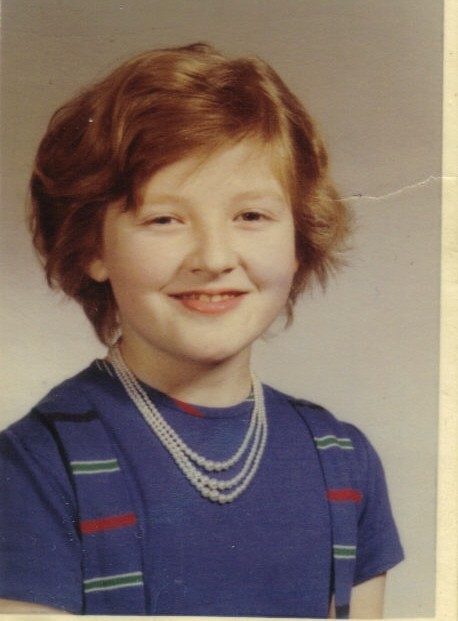
4. My first home perm, a Toni, applied by Carol. Here’s me in my Grade Five school photo, age nine.
5. Lobster! The first lobster I’d ever seen was on Carol’s kitchen table, as a special treat for Gilbert. I could not imagine anyone eating such a gross looking creature! I don’t think I was even aware of the existence of lobster at the time, nor the fact that they were not inherently red, or how they were prepared. Imagine my 8 year old eyes widening with astonishment.
6. Gilbert’s nickname, thanks to Grammie, was Gilligan, from Gilligan’s Island, a tv show that Grammie loved. It first aired in 1964, and ran until 1967. I have no idea why Gilbert reminded Grammie of Gilligan, but I think they were both funny, and definitely both young.
7. And lastly, I remember playing Rook with Carol, Gilbert, my parents, and grandmother, around my grandmother’s table. No, not quite so, as I was too young to play cards, but I often sat, even as a tiny child in a high chair, during their games, with my own set of cards. I remember Grammie laughing that Gilbert much have the lucky chair, as he so often won. She thought trading chairs might help. I’m not sure that it did.
So, falling into wakefulness last night, with the realization that I no longer needed to babysit Carol, fascinates me. I decided this morning to pull a card from my Wild Unknown Tarot deck for more insight into this sense of freedom. The Empress card flew out of my hands as I shuffled. This card features a dark starry night with a crescent moon, and, in the foreground, a brilliant white tree, with leaves shifting from white to pink to red, and purple, bright against that dark sky. No matter how dark is our night, the Wild is with us to renew us and keep us in beauty.
(I’ve been thinking about all the Bible stories where the Wild comes to the rescue, where the Wild shapes the recollection of history – how the Pharoah of Moses’ day suffered under a series of natural plagues, how the Red Sea drowned the Egyptian army, how a big fish rescued Jonah, how Noah’s flood changed the world for a new beginning, how brimstone poured down on Sodom to punish the inhospitable inhabitants. The other day, when I was distraught at what is going on in our world, the Wild told me that she’s got it. She, the Wild, Mother Nature, will clean up the mess we humans are making. Mother Nature will be Wild in her cleanup, but the Sacred Wild is still where we need to turn for solace in our distress.)
I often read Carrie Mallon’s insights about Wild Unknown tarot. She says this Empress is “unapologetic about taking up space.” The tree is deciduous, following the rhythm of the year, the rhythm of life. Babysitting an adult when I was 8 or 9 was not an appropriate job for a little one in the spring of life. This falling into freedom is about following my own natural rhythms, paying attention to the reality of my body, and who and what I am now. It’s about allowing myself to flow, and to live in this soft body with affection and joy.
“When the Empress appears, consider what you are nurturing,” Mallon continues. How long have I been nurturing what is not mine to nurture? How long has little 8 and 9 been care-taking? “Are you tending to yourself with as much reverence as you would give to someone you love dearly?” Mallon asks. “Step fully into your authentic nature.”
When I was 8, I believe I was a Master Conflict Avoider. Little Me knew, for example, what was upsetting adults, when the government decided to expropriate land, and flood the river valley to generate electricity. Little Me could read the paper, too, after all. But she protected the adults from her knowing and her feelings. She thought she had to deal with her own response to world and community events all by herself. The grownups had enough to deal with.
But Little Me is also grateful to Carol for time away from home. My house was full of siblings. What a treat for me to be able to play Roses Are Red My Love with no one telling me to be quiet. My daily trip with Carol across the road and along that narrow driveway gave me quiet space to fill with my authentic self. Thank you, Carol, for giving me that freedom. Thank you for the perm and the music, and even the memory of that lobster.
Love you!
Alice

 Dream Bringer’s Studio