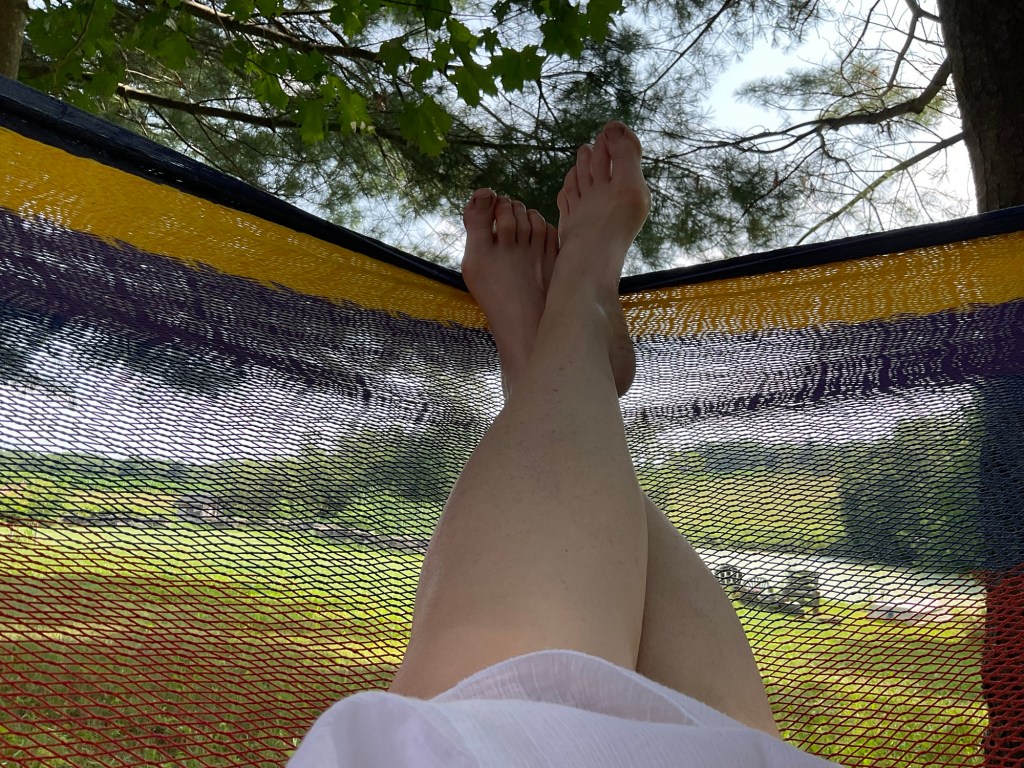
This morning I went for a walk, early, due to the heat wave that has me now in the hammock, enjoying the breeze under the trees. But this morning, I walked from home to the beach, just to be able to say that I did, just for the exercise, just for the time to myself. On the way back, I accepted a call from a friend halfway across the continent. We talked all the way home, about 3 km. For a while, it was our usual chat. But interspersed with dialogue, I showed her some of the landscape.
I showed her the hill I had dreamed of climbing, to borrow a little red sports car. I showed her the graveyard where relatives and neighbours are laid to rest. And then I came up the last half mile, into our family neighbourhood. This is my brother‘s house, I said. This is another brother‘s house. And today is my other brother’s first wedding anniversary. I had the privilege of officiating that wedding. Today the family message group is full of congratulations back and forth, and teasing about the time passing quickly, whether it’s one year or 46.
And here is the shop, my brother’s shop, with maple syrup and other maple products, and vegetables. What do I need today? Oh, and here’s a neighbour — second time I’ve seen her this morning. I’m happy to show my friend what my neighbourhood looks like. When I leave the shop, who appears but a great nephew. “Hello great nephew! This is my friend!” I walk a few steps further and, “Oh, here comes my nephew! Nephew, this is my friend!” Here’s the house where I was born. And here’s where my nephew lives, and here’s the orchard. Oh, and now we’re home.
I tend not to recognize the joy of being able to walk along the road and see my neighbours, and my nephews and great nephews. I forget how privileged I am to purchase green beans and romaine, grown right here on the farm. I live a magical mystical life, so fortunate I am.
So fortunate to be in this kind of life, where siblings text one another congratulations, where nephews and great nephews come out to the road to say hello, and to ask questions like what did you buy today? Or do you still need to know if you can use the church to marry us? Yes, another family wedding is coming this fall. It’s a joy and privilege that I forget I enjoy. But right now, I remember. Right now, I am filled with gratitude, as I swing under the trees, in my hammock on this heat wave day, bare feet to the sky.
The other day, an ad popped up that drew my attention. Someone’s daughter had been bitten too many times by mosquitos, so many bites that the dad determined to do away with the mosquito population anywhere nearby. Apparently he invented a mosquito killing gadget that attracts mosquitos from far and wide. Now his daughter luxuriates in a mosquito free environment, while her dad (or maybe her mom) is kept busy dumping dead mosquitos out of the tray. No DEET required.
For a moment I thought how nice it would be to spend a summer without mosquitos. Then I thought of all those tiny lives, and all the birds, fish, frogs, turtles, salamanders, and small brown bats – all unable to get their dinner because humans want a mosquito-free life. I decided I’d rather use DEET. I’d rather sacrifice my comfort for the sake of those other-than-human parts of creation.
Yesterday, the Sunday before Earth Day, I was thinking about the definition of true love as sacrificing one’s own life for someone else. But sacrificing one’s life for love does not have to involve dying. It’s also about sharing. If we have what is needed to make a life in this world, but refuse to share, how can God’s love be in us?
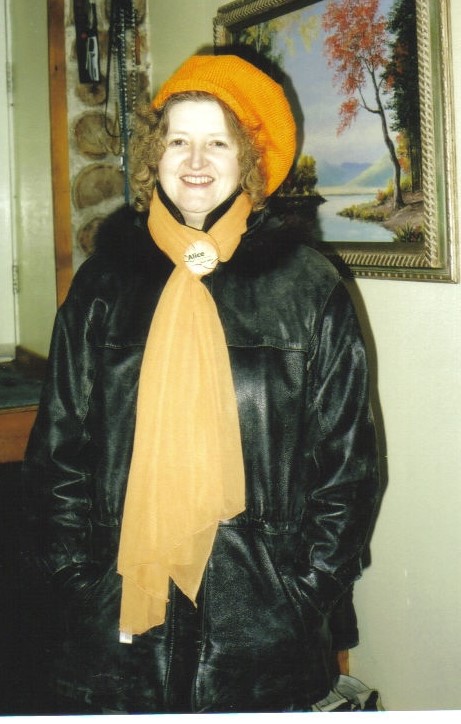
I remember a time quite a long while back, when I came across an absolutely delicious soft black leather jacket. The leather was so soft. The style so fitting. The price so outrageously high even at half off. But I bought it. I bought it. And then! Well, then I found myself donating more than that amount to charity, out of guilt. Leaves me wondering how often what might look like sacrificial love is actually guilt.
How many of us condemn ourselves with storms of guilt, but don’t make any changes in how we live our lives? Sharing needs to be a way of life, not just an idea or theory. I’m talking about sharing with all those other beings in the world, not just our human family. Are we not called to share with the family of Creation also?
Are we willing to give our lives for the frogs? They say frogs and toads are exceptionally good “indicator species”. So many things make them susceptible to climate change. They are like the canary in the coal mine, used in the long past to let the miners know when the mine was filling with carbon monoxide. The canary would die of asphyxiation much sooner than the miners, and served as an early warning system. The canary gave its life. Out of love? I wonder.
What am I willing to let go of, or sacrifice, for the sake of the frogs? Most of the time, I have to admit, I don’t feel willing to let go of much. I say I love frogs, but how much of that is just talk? But if I don’t share what I have, if I don’t share the world with the frogs, does true love really live in me?
The love we have for frogs, for whales, for coral reefs, is all too often just talk, or just theory. Can we become willing to share? Can we become willing to actually give up some of what we think is our human birthright, in order to protect and care for those other creatures?
We often say that what little we, as individuals, can do for the frogs is so little that it hardly matters. We can call it a systemic problem, and bemoan that each of us has no hope of making a difference. BUT if I look after my back yard, and you look after yours, that adds up. There’s a movement now, a grassroots call-to-action, known as Homegrown National Parks. Author Douglas Tallamy says that if each of us began to change our grass, our lawns, into plantings of native species, and if we changed our outdoor lights to yellow bulbs, we, one by one, together, could be nature’s best hope.
Are you willing to give up your lawn for the bees? Are you willing to give up your dusk to dawn light, in exchange for a motion activated light with a yellow bulb, for the sake of the moths?
We can’t just talk about our love for Nature; we have to live it. And that is soooo hard. I think about how people respond when they hear that I do not eat sugar or flour. That’s not for the sake of Creation, but it is for the sake of the piece of Creation that is my body. A lot of people cannot imagine giving up sugar and flour. I’ve even heard people say, “I would rather die young than eat like that.” Such a sacrifice, they think. But my body is grateful for that sacrifice.
We can’t just talk about change. We have to live it. Unfortunately, even though our guilt or our love is strong, so is our sense of helplessness. What hope do we have to save the planet? Yet, something needs to change. We know something needs to change. We just hesitate to make the changes necessary, for the frogs or the coral reefs.
It may be too late for the coral. Sea water is too hot for coral in many places. In the last year, half of the world’s coral has experienced heat stress, the worst to date. Loss of coral means loss of fish, loss of food, and loss of coastal protection.
How much we condemn ourselves and each other, but we can’t let self-condemnation remain as hopelessness and helplessness. So ask for wisdom and insight. Ask what you could do, what changes you could make in your backyard. Yard after yard, we could have a national park, as Douglas Tallamy says.
How will we know we are on the right path? You know you are on the right path when you feel the Presence of the Sacred with you. So here is your Earth Day assignment: Walk or sit outside in your own property, and ask for wisdom. Feel into the Presence of the Sacred , there in your back yard. Listen to what the Sacred is saying to you. Hear the wisdom that speaks to you in your heart of hearts. But don’t just listen; let it become part of your life, how you live, how you share what you have with those other-than-human beings all around.
On my way to church yesterday, I came across a fox, a red fox, dead on the center line of the road. I drove by, but then had to stop and turn around. I went back to move this wee fox, so small, so beautiful. I had never touched a fox before. It was so soft. Such brilliant fur. Such a precious piece of creation. I ran my fingers over its body, and said a prayer for it’s wee soul.
Today I remembered that black leather jacket, that delicious black leather jacket, and the fox fur trim on the hood. And my heart grieves.
Once upon a time, in a land far far away, there was a lame man, begging in the temple. Every day someone brought this man to the Temple to beg, placing him by a busy gate, in the midst of the traffic. He had been paralyzed from birth, we are told, but we do not know how small he was, how young he was, when they first carried him here, to earn his living. Probably very small. People have pity on small children.
Those people had watched this happen, day after day. They would see him settled into his place, perhaps gently, perhaps not. People would see this the way we see what is always there, seeing, but at the same time, not really seeing, because we don’t see, really see, what is right in front of us, day after day.
You have seen beggars before, street people we call them, cap in hand, or a coffee cup or bowl on the sidewalk. But do you really look at them? The pattern is the same now as it was long ago. The beggar notices you, looks down, and asks for money as you pass. Or, you notice the beggar, look away, and either to dig into your pocket or purse, or step around them.
But this time something was different. Peter and John stopped. They actually stopped. They had probably seen him before, maybe they had given him money before. But this time, they stopped and looked right at him. We know the beggar looked away because Peter said, “Look at us,” and the man looked up. He expected money, but Peter’s hand was empty.
Peter’s hand, a strong fisherman’s hand, was reaching out to him. “Stand up and walk!” Peter said. And Peter took the man’s right hand, to help him up. Peter told him, in the name of Jesus of Nazareth, to get up. “Get up and walk!”
And the guy got up! You would think that after a lifetime of being unable to walk, that he would be weak, helpless, wobbly. But no! His feet and ankles were strong. He could walk! He could jump!
This guy had been lame all his life. He had been there in the temple begging, every single day. Everyone knew him, and everyone hardly noticed him. People stop noticing what is usual, but when something unusual happens, they notice right away. And this day, everyone knew that something astonishing had happened. This was unusual! They saw this with their own eyes, that this man who had never walked before was walking and leaping at Peter’s side.
As I thought about this story, just after the total solar eclipse the other day, I thought of all the people who gathered to see that unusual thing. We see the sun. We see the moon. The twilight comes every day. Sometimes we pay attention, often we don’t. But the other day, we gathered because something amazing was happening. Imagine the same sort of hubbub in the temple that day, as people reacted with astonishment.
Peter saw his opportunity, and began to speak to the crowd. He told them that faith in Jesus had healed this man, the same Jesus they had given to Pilate for crucifixion. It had been only days since Jesus had stood there, right there, tossing over the tables of the money changers, and chasing out the livestock. THAT was unusual!
It was also only days since Jesus was arrested and killed. Sadly, though, crucifixion was a USUAL occurrence. Sometimes hundreds would be crucified at once. What WAS unusual about this crucifixion, Peter said, was that they had killed the Author of Life. The Author of Life – the one who spoke creation into existence, the one who was there from the very beginning, the one who had come in human form because of love, not love just for the humans, but for the whole creation.
Jesus often spoke of creatures that were other than human. He spoke about sheep and goats and wheat. He taught that God loved little birds and lilies. He said that if God looked after birds and lilies, God would look after people too. We are part of that creation, beloved by God.
Part of creation, and yet we tend to separate ourselves, as if we are above or better than the rest of creation. We say we humans are unique. We ARE unique. But we are still part of the created world. Yet, somehow, it was only the human animals who killed the Author of Life.
It’s like how they were saying that the four-leggeds, and the winged ones, did not need to be warned to avoid looking at the sun during the eclipse. Only human creatures need those warnings. So Peter told the crowd that they had killed Jesus out of ignorance. They did not understand. But not understanding what we are doing does not absolve us of responsibility. Just like not understanding the danger of looking at the sun does not protect our eyes from the consequences of our ignorance.
These days we may not be actively killing the Author of Life, but we have been killing Life itself. Some people have said that it doesn’t really matter if we destroy this world, because there will be a new heaven and a new Earth, and the sooner the better! But it DOES matter. God gave us THIS Earth to tend and care for, not to use until it is all used up!
I worry about what we are doing to this planet. I also get angry. A lot of people are angry these days about the carbon tax. I don’t know if it is going to work like they think it should, but do any of us have a better plan? I get angry at government policies and corporations that pay more attention to the bottom line than to the issues facing this planet.
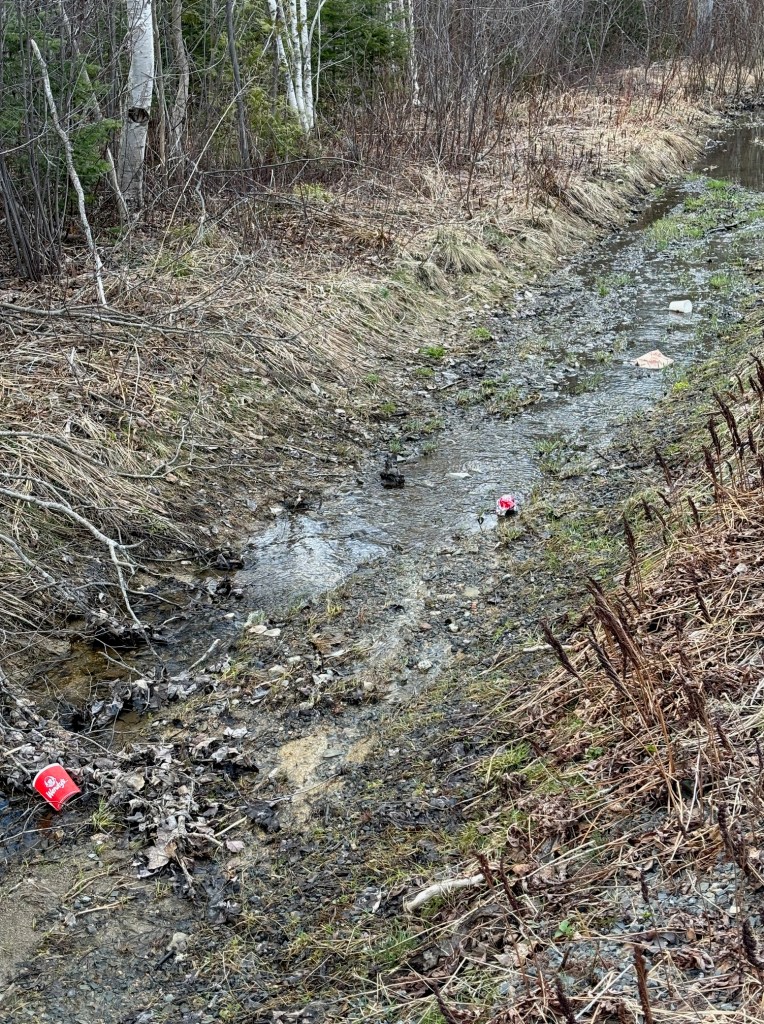
I get angry at forests disappearing. I get angry when people throw garbage into ditches. The other day, out for a walk with my husband, I decided I needed to walk that route again, with my rubber boots and garbage bags. And then the very next day, I found this, in my freshly cleaned ditch.
Anger is like a flashing red light telling us there is a problem. Anger is supposed to give us the energy and motivation to do something about that problem. Anger is what should be natural for us to feel when we think about what is happening to our Earth today.
But we need more than anger. We need love. If we are not in love with this world, with this earth, these trees, these birds and animals, if we are not in love, then we will not feel anger. We need to realize, when we say we are all part of one family, that we are part of more than just the human family. We are part of Creation. We need to think of ourselves as one of the creatures of the forest and field.
As Geneen Marie Haugen wrote, in a book called Spiritual Ecology, we should approach the rivers, mountains and dragonflies as if they are intelligent, and infused with soul. Isaiah wrote that the mountains and the hills would break into singing, and that the trees of the field would clap their hands. The Book of Job tells us about when the stars sang. The prophet Habbukkuk wrote that the stone in the stone walls would cry out, and that the woodwork would respond. And Jesus declared that if the people were silent, the very rocks themselves would cry out.
Most of time, we read those verses as metaphor, but what if that is the real nature of nature? What if Creation itself really is crying out like a woman in labor? What if Creation cries out, in praise, or in anger, and we just don’t see it? Or hear it? What if the grief of the world, of Creation, has been right there, right in front of us, every day, for so long, that we no longer notice? What if we step around the needs of Creation, just as we so often step around the needy person on the street?
Instead, could we take time every day to stop and really look? We took time the other day to pause in wonder at the eclipse, at the changing light, at the rising wind, and the response of the birds. Couldn’t we do that more often?
Couldn’t we be like Peter and John, stopping to actually spend time with the one who was in trouble? Peter and John stopped and spoke to the beggar. They connected with the beggar in a new way. They offered help, a hand up. They offered love and companionship. And they entered the temple together.
I’m just back from a walk. I didn’t quite make it to 10,000 steps before the rain. Yesterday, thanks to two separate walks with my friends Natalie and Shirley, I managed to log 15,000 steps. I must admit, though, that when I am driving, my IPhone interprets some bumps in the road as steps. I suppose one could think of that metaphorically, the bumps in the road, helping us to meet our goals.
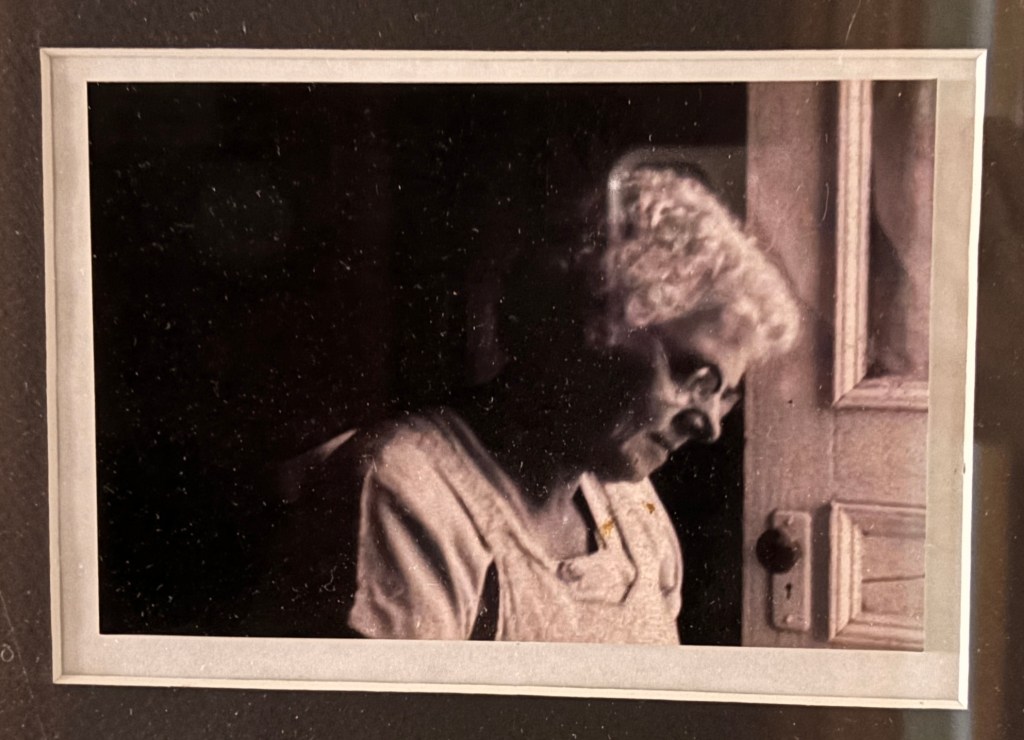
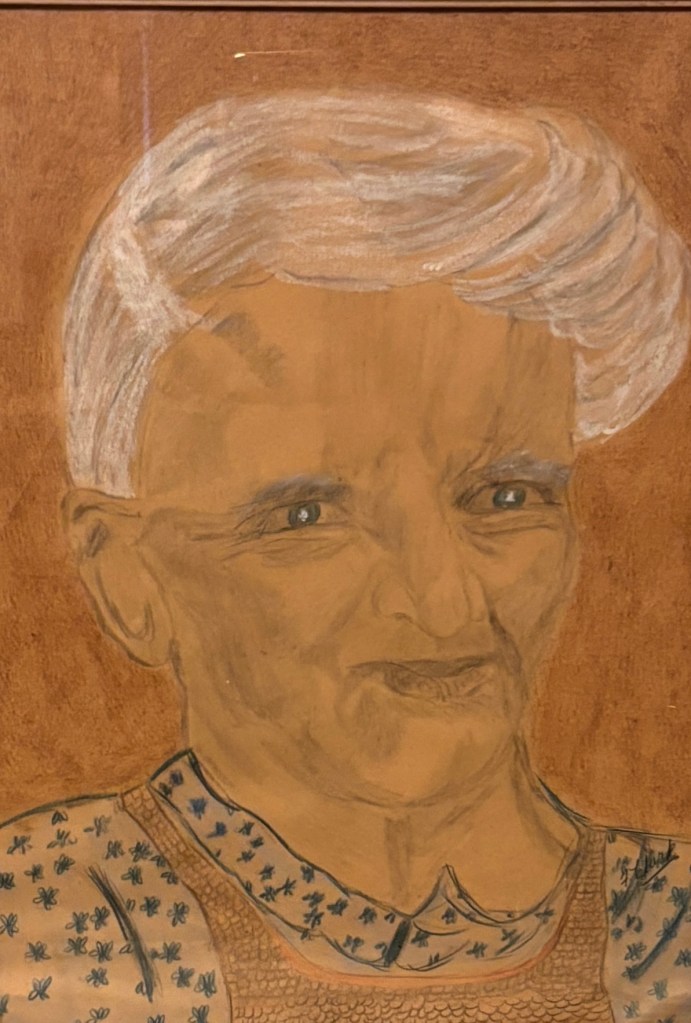
Saturday I walked just 5000 steps, on my usual shorter walk out this road and back. I had decided I would take a stoll with my grandmother Gertie, Mom’s mother, who died when I was barely six. I have many fond memories of her. She makes a fine companion on the road.
We, she and I, were chatting about long walks in retirement, and she reminded me how neither she nor my mother managed to reach the age that I have achieved. My mother didn’t walk far in the years before her death at 62, thanks to her dreadful arthritis. I don’t recall seeing Grammie going for a walk either, but then my entire memory of her is kitchen centered, either in her own kitchen or the kitchens of relatives nearby. There were lots of those, almost like a family compound up and down her road, sort of like what I enjoy here on my own road.
So Grammie reminded me, Saturday, of how HER mother, Ada May, loved to walk. She would even stop along the way and rank up other people’s firewood. I often think of her when I am stacking wood. But Saturday I was thinking of walks and stops as a pleasant retirement activity. I thought of who I could visit along the way, stopping for a rest and a cup of tea. That was the moment I decided to intentionally change my walking patterns.
Today I walked to the corner store, almost 3.5 km away, and mostly downhill. I stopped there for a coffee, before heading back up the hills toward home. The only visit today was with my brother in the barn yard, in the rain. Tuesday I visited my mother’s friend. She was sitting on her front step in the sun. In the days to come, I plan to visit other neighbours. I’m practising for retirement.
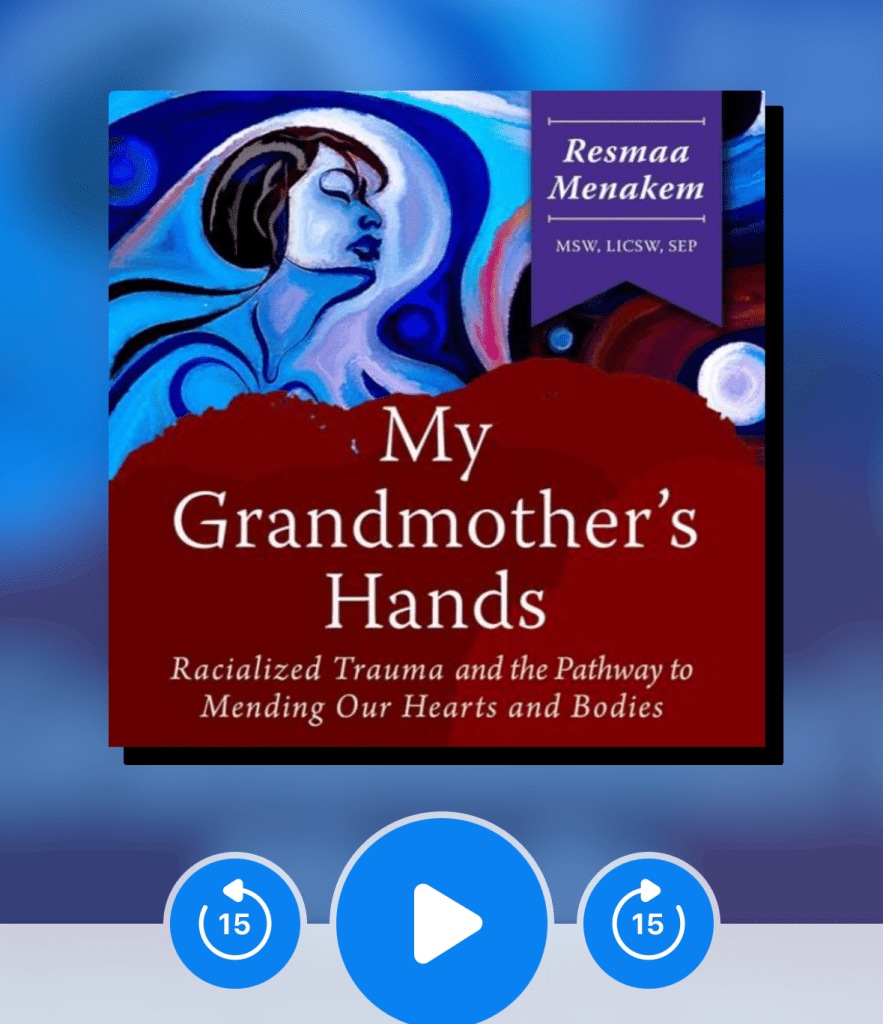
But today I was also listening to an audiobook, My Grandmother’s Hands, a book about how our bodies hold the trauma of our ancestors, and how that embodied trauma effects our relationships today. Until we heal our own trauma, in our own white bodies, Resmaa Menakem writes, we can’t expect to grow beyond the racial divide.
And so, I was walking with my ancestors, wondering how their traumas affect my worldview. It’s not just the recent trauma of recent ancestors. The trauma of our ancient European ancestors is encoded in our bones, in our DNA, in our bodily heritage. The terror of marauding bands or crusading armies, even the early expansion of Christian empire, all of these things sit heavy in my heart and my belly.
So I take my body for a walk, and think of the history that I know so little about, and my place within the current ecosystem of our society and economy. If you see me walking alone, I am never really alone. Guaranteed.
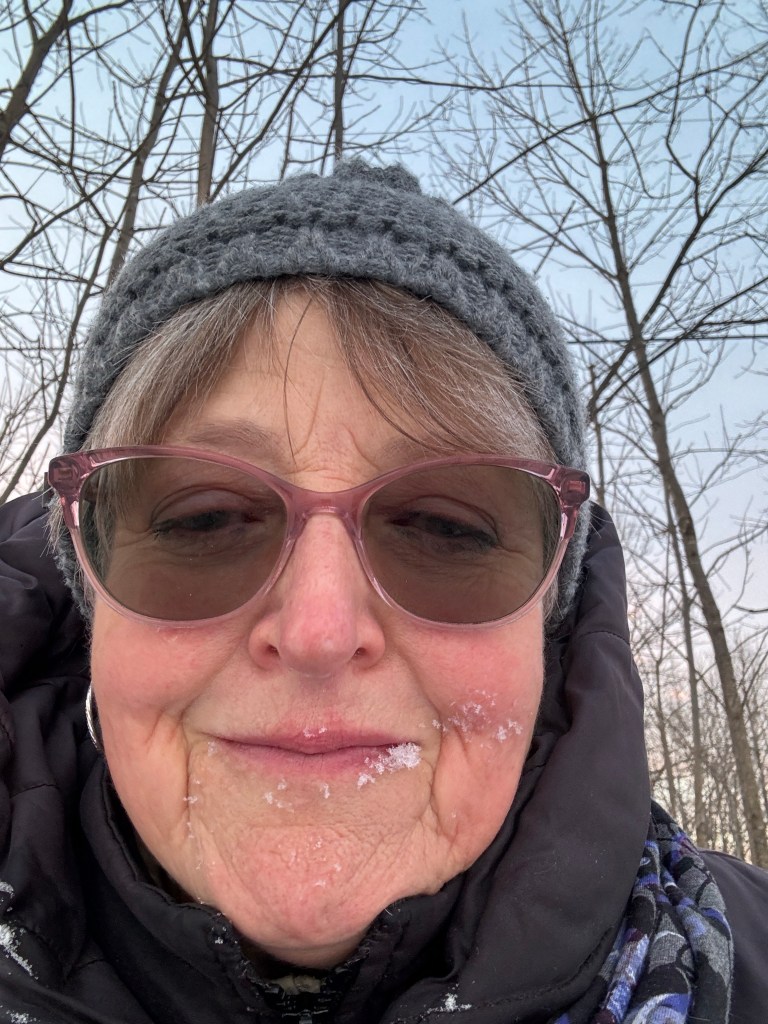
Outdoors all by my SELF! Sliding on the BIG hill, ALL by my SELF! It was FUN! Fast and cold! Spin around, fall off, Backwards into snow. I am four! Four times down. Fun and scary. I am four, ALL by my SELF!
Cars. A crow. A chickadee. My tummy. Cold on my face. A tear fell down. Smell the trees laughing. Snow like candy. Yum! More! Pink and purple sky, Gold and blue.
The grownup man says I have to tell him first. Pouty face. No! I can play ALL BY MY SELF! I am four!


 Dream Bringer’s Studio