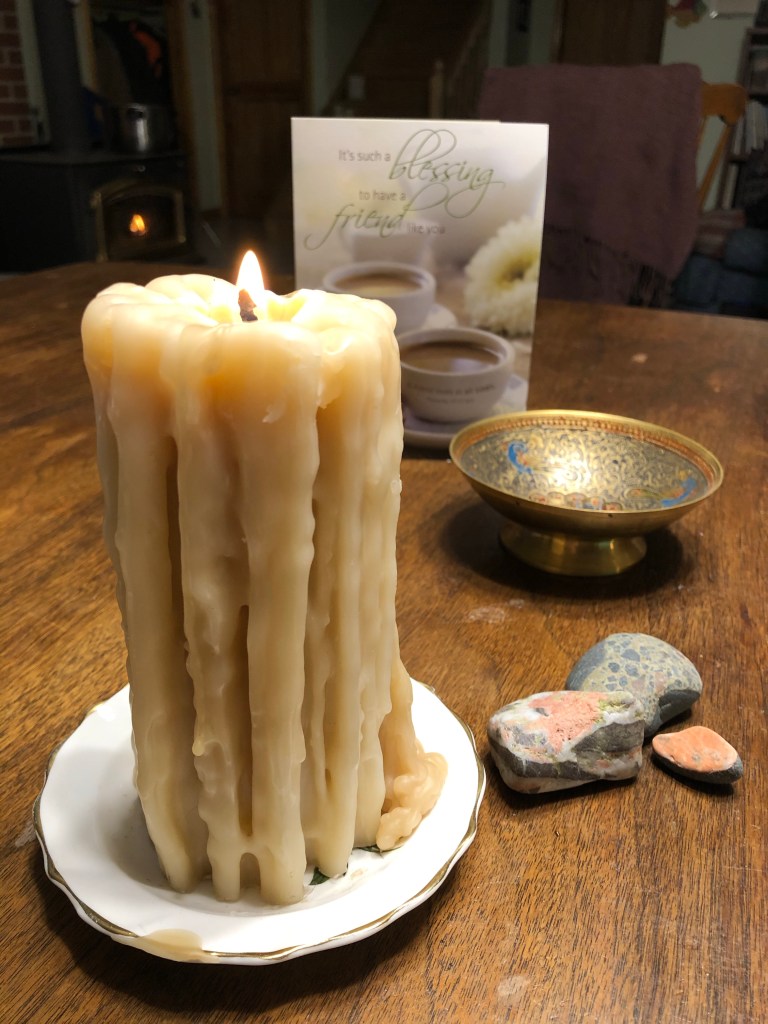
Early morning prayers and a candle lit for peace … but it keeps going out! Last time I used this candle, I pressed the soft wax back toward the wick, too tightly, perhaps. The candle sat on my shelf, beautiful, for almost a year, unlit, and now when I want to pray for peace, I find the flame needs close attention, as I relight it again and again.
Is that not the way with peace? We have an extended period of calm, and then let it sit on a shelf too long, trimmed up and beautiful, but unattended and fragile. We don’t see how fragile is that light until we want it, need it, long for it, only to find it isn’t there, nor easily regained.
The flame of peace goes out when we don’t watch over it. The flame of peace needs attention, coaxing, care. Turn away too long, expecting it to burn on its own, and the light goes out.
In the darkness, we need to huddle close to this light, and to each other. We need tenders of the flame, fire keepers, peace keepers. And if your candle of peace goes out, relight, and relight again! Relight that flame of peace again and again, and sit close with your loved ones. Pay attention to this fragile peace. Do not give up.
Happy 2021! A few weeks ago, I was asked to prepare a video lecture for students in the Human Services program at the New Brunswick Community College. They, like everyone else, are doing virtual classes in our COVID circumstances.
Now that the students have had their turn, I’m making the video public. Most of it can be instructive to anyone, student or not. I trust you can be patient with those parts that don’t apply. 😊
The beautiful words of Pslam 23 have at times prettified me and given me hope on some of my darkest days.
I wrote this poem just to reflect on the pslam and how important it is to me.
As I wander through the green uncut grass
the stories of the garden unfold.
Imprinted into the soil, deep dark tunnels of despair,
My burdens glistened into the dewy footprints of life
I know that I am the gardener, listening to the creator.
With every seed thats sown, I learn more of him.
When I doubt, he lifts me up, reminds me that I can grow.
He leads me through valleys that I never knew existed,
waters my soul with life giving streams, which hydrate me.
Growing in a new place, Where its safe to sit and stay.
With him I am at peace to say no words, as he knows my…
“The best criticism of the bad is the practice of the better.” ~ Richard Rohr
This morning, with my coffee, I read, as usual, in no particular order, my email, Facebook notifications, and news. Some of my email is summarized news, which is where I started today.
I’ve come to believe that coffee energizes or unnerves me, depending on where I am emotionally to start with. Yesterday I was energized. The day before, I was shaking with anxiety. Same amount of coffee. Hmm. What’s that about?
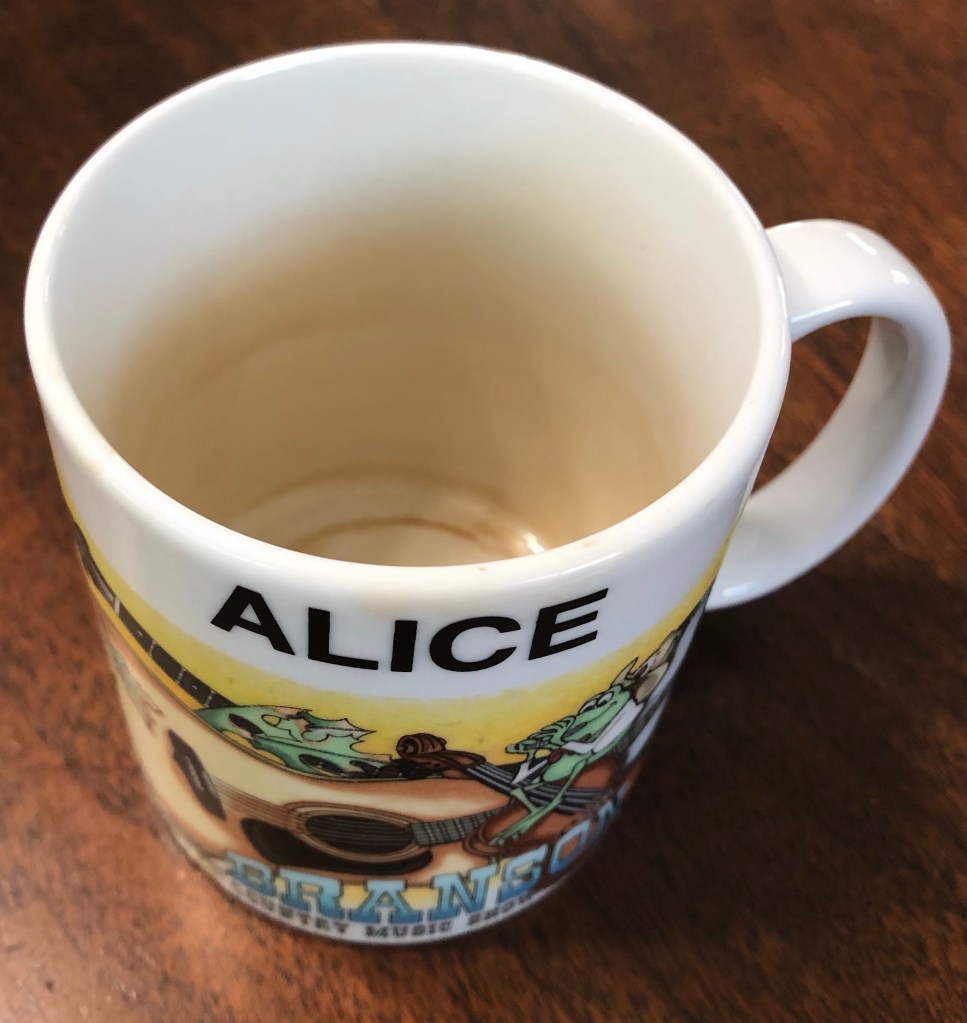
What it is about is my responsibility to myself, to appropriate self-care, looking after my own emotional state, first and foremost. I need to clean the inside of my own “cup”, as Jesus advised.
He said this, according to the Gospel of Matthew (23:26), as part of an extended exchange with the religious leaders of the time, who were also in many ways the political leaders as well.
The exchange comes shortly after his “Triumphal Entry” into Jerusalem, riding a donkey, an event we celebrate even today on Palm Sunday. That day, Jesus rode into town to the fanfare of the crowds, going directly to the temple, where he drew the ire of the religious leaders by tossing over the money changing tables.
Money changing was part of the onerous level of religious expectation. You couldn’t use Roman coins for your temple gifts and shopping. Yes, shopping. The temple grounds were filled with animals for sale at exorbitant prices. If you wanted to make a sacrifice, of the required type and quality, you paid through the nose. Jesus called the temple a den of thieves, rather than a House of Worship.
This exchange was the beginning of the end for Jesus. The political system and religious system worked together in earnest to precipitate his arrest and death. It’s like Jesus decided that under the circumstances he could be pointed in his comments about that system.
He told them a story about two sons whose father asked them to do certain tasks on the farm. One son said, “Sure, Dad!” and then as some sons do, went on to completely ignore the father’s request. But the other who at first said “Nope! Can’t help you, Dad,” went on to do exactly what he had been assigned to do. Which son, Jesus asked, was obedient?
The answer was an easy one; the second son was obedient. “Well,” replied Jesus, “be aware that people you look down upon from your critical high horse are likely much closer to God than you.” (My paraphrase.) Jesus went on to tell more stories critical of leaders who were disrespectful of others whom they regarded as being below them. The God who had always asked them to be fair in their care of widows and orphans, foreigners, and the poor (Jer. 7:5-6), was saying they obeyed in word only, focussing on outward behaviour instead of the intent of the heart.
And so, Jesus concluded, they should look to the motivations of their own hearts first. They should clean their own cups, the insides where the tea stains accumulate, rather than pointing accusing fingers all around.
Today, my body reacted to stories like that, as evidenced by how shaky my handwriting appears in today’s first journal entry, after only one cup of coffee. I turned to my daily email from Richard Rohr, whose gentle words would soothe my soul, and found the quote, above, “The best criticism of the bad is the practice of the better.”
Rohr, in an expansion of that statement in another document, reminds us that “when you don’t transform your pain you will always transmit it…, that we cannot afford to hate because we become a mirror, a disguised image of the same.” In the face of all that, we usually either fight or hide away in denial. Rohr suggests a third way, of fighting AND fleeing at once into the heart, where we clean our own “cup”, as Jesus said.
That is indeed a fight, as we struggle against our natural tendency to point fingers. What Jesus did, in the midst of trouble, even minutes before his unjust death, was to forgive. Cleaning my own cup means looking inside myself, centring into the Presence of Spirit, trusting and letting go.
This post is part of my process. May it bring you readers some peace as it has for me. May this become our better practice.
I want to brag. Perhaps I shouldn’t, but I will anyway. I’ll start by saying I have two gorgeous delightful smart-as-a-whip grandgirlies. That is a typical grandmotherly thing to say.
I am married to a science teacher. He found a video called The Infinite Pattern That Never Repeats. He watched it, told me about it, and we watched it the next evening together. So interesting! Mind blowing science that I really don’t understand, but it is beautiful. I sent a link to my daughter, saying she and the girls would like it. I was thinking particularly about 5 year old Anna, the artist.
Of course, as things go, when watching YouTube, we ended up watching more, including this one: Parallel Worlds Probably Exist. Here’s Why. It has a hilarious explanation of Schrödinger’s cat, a thought experiment regarding quantum physics. If you put a cat in a box, and set up circumstances that may or may not release poison, is the cat dead or alive? Both! Watch and see.
An anxious Pixie
Pixie was watching intently. She did not like that experiment! I don’t blame her! Good thing it was a thought experiment, all in the mind of Schrödinger and in the pages of physics textbooks everywhere.
So Daughter Dear and the girlies watched the first video, and like us, kept on keeping on with more. Anna chose this second one. And wanted to DO the cat experiment! Wise daughter suggested a different experiment: Slinky Drop. This is a safe experiment that anyone can do, with a slinky and the slow motion setting on your phone. No cats are harmed. 😂
In our COVID world, there are so many ways to learn, to share, to love, and to be present. I got to see the result of my girlies’ slinky experiment, even though they live a thousand miles away. They learned things about science that may inspire their future careers and creativity.
We can put too much focus on the scary things in the world, but if we look instead with wonder, we can experience joy and gratitude instead of fear.


 Dream Bringer’s Studio