Of all the willows on this land, one is very old. Years ago, she fell. She lies broken, partially uprooted, but flourishing.
She told me of the falling, of the happy movement through the air, and then — the crash, the multiple fractures, the silence.
She rejoices, closer than ever to her beloved Earth. She reaches down, down, into the mud, and up, up into the sky.
She weaves thin branches into shelter for small ones, perches for sparrow and blue jay, and gateways to the Land of the Fae, the strong fallen trunk perfectly placed for this Human who comes at last, to sit and chat. These, she says, are gifts in disguise, that come — soon — in tree years — after the trauma of upheaval.
Her message, to me, to all of us, is to flourish despite age or injury. Rejoice with me, she says. We are One. We are eternal.
I ask for a piece of herself, to hold, to cherish, my attention drifting from budding twig to dry branch, easily snapped.
I realize, now, she has given me a Willow Wand, for ritual and magic, capable of fire, and so much more. Yes, I say. Yes.
They say Christmas is a peaceful time. Sometimes I feel it, but not often. Again this year, I wonder when – when will there be peace, real peace, on this planet?
Closer to home, there may be anxiety about Christmas visitors, travel and winter weather, and family dynamics. Far too many people face the worry of not having money for gifts, or a Christmas dinner, or even a place to live. And, if you are like me, you might catch yourself saying, “I don’t have enough time to finish everything on my list.”
But then I remember what my friend Sassi told me one Christmas years ago. It was December 23rd. With a long list of errands, I started my day at the office, tying up year end, before setting off to Sassi’s place for our Christmas lunch, probably soup, her specialty. We exchanged gifts, but the best gift was her parting message: “Remember, you have all the time in the world!”
All the time in the world? Really? On December 23rd? But, I realized, I didn’t actually need to stop at the hardware store. Whatever my husband thought needed fixed could wait. He wouldn’t get to fixing, until well after Christmas anyway. Instead I went straight to the mall. I had a gift to deliver to a friend who worked there. When I arrived, she was just going on break. That perfectly timed fifteen minutes was exactly enough.
Then I zipped around, doing the last of the Christmas shopping, before heading to the grocery store. You know how the grocery store is right before a holiday. The aisles are crowded. People are in a rush, wild eyed. But don’t you know, they still want to chat, offering Christmas wishes.
As I grabbed one of the few remaining carts, I remembered Sassi’s words. I took my time, found what I needed, and stopped, of course, to wish friends and neighbours a Merry Christmas. At the check out, the woman ahead of me exclaimed, “I’ve been here for two hours!” I glanced at my watch. I’d been there half an hour, only half an hour! It was as if time had expanded. All the time in the world, just as Sassi promised.
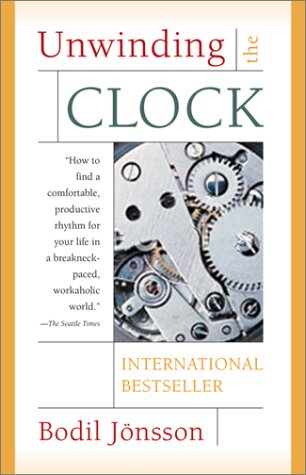
Time is a relative thing, long hours and short years. I have a little book called Unwinding the Clock, by Bodil Jonsson, a Swedish physicist. She made me laugh at what she said about how women deal with time. “How many ‘soons’ are there in a quarter of an hour?” When my kids were little, I’d set a timer, one of the old wind up ones, that tick, tick, ticked as the minutes passed, until the loud “ding” that said it was time — time for the end of their time out, or the end of their turn with a favourite toy. That was clock time, precisely measured.
Sometimes one minute seems like forever, and other times you wish that one minute really was forever. In the hours and days you spend at someone’s bedside, when you count the breaths, or the seconds between breaths, all the years you’ve had with that person are never enough.
Or the long days spent waiting for Christmas, when you are seven, and the forever long night of Christmas Eve, which for the adults is never long enough. The long wait to grow up, that never seems to come, and then suddenly you are there, adult, and scared to death because somehow you still feel like you are only five?
We divide our time, try to save time, wish the time was over, wish for more time. Bodil Jonsson says that time is the only currency we really have. We spend time, we waste time, we budget our time. She says to think of time as going into a wallet, a wallet with four pockets. One pocket is for money, one is for relationships, one is for the things around us, the natural world, our tasks, and the fourth pocket is for our inner world.
How much time have you spent making money? That’s time put into the money pocket. We put our time into the money pocket and think we will get it back when we retire. But we all know someone who didn’t make it to retirement, all the time that went into their money pocket, gone. How many people lie in their death beds wishing they had put more time into the money pocket?
More often, people regret not putting enough time into the relationship pocket. Have you ever wished for more time with your loved ones, to ask the questions that seem important now, that you never thought to ask your grandmother when she was still there, time to understand and know loved ones differently? That is time we cannot buy back, with any amount of money.
We wait and wait, counting long days, and then, the day is here, suddenly. That day we have been waiting for is here, and gone. In the season of Advent, we wait for the coming of a baby, born centuries ago. We wait in anticipation for Christmas, a day that comes every year.
If we indeed have four pockets in the time wallet, for money, for people, and for every day tasks, let’s not forget the pocket for our inner world, our spiritual selves, our heart, our inner peace. One of these days, just like it will suddenly be Christmas, one of these days, it will suddenly be the beginning of the next segment of this amazing journey called Life.
You have all the time in the world, you know. So take a breath, breathe, sit by the fire, or enjoy a winter walk. Talk to the moon in the early morning. Speak to the Blue Jay and the Willow Tree. Dance in December rain, and find a moment’s peace. Let it expand to fill your heart, and smile. You have all the time in the world.
[Note, a sad note – my dear friend Sassi left us for the Spirit World in May 2023. In a way that tells us that there isn’t REALLY all the time in the world. But Sassi is the sort of friend who finds ways to drop into our lives from wherever she is, sometimes MORE present in spirit form than in the physical. I can hear her giggle as I write this.]
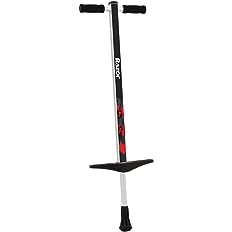
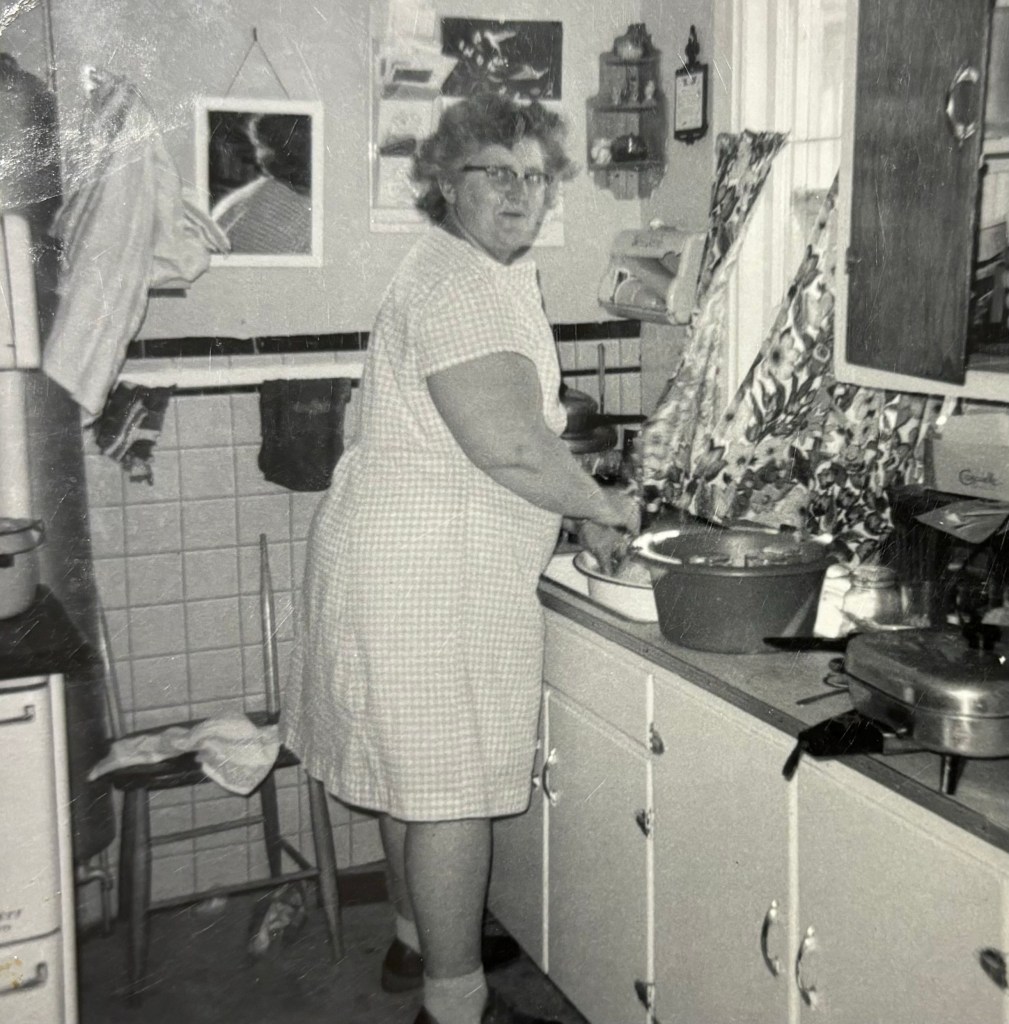
My sister had a pogo stick. She used it a LOT! The whole house would shake whenever she jumped around the kitchen. We had a BIG kitchen in the farmhouse, with plenty of room for jumping and playing, working and cooking. So much happened in our kitchen, the heart of our home.
One day, we had the good fortune of laying a new vinyl floor. I was a kid, so I have no idea how much Mom and Dad skimped and saved to get this heavy duty vinyl. I remember it as grey, rather plain, but new.
Mom was excited and happy, until, that is, she noticed many small moon-shaped cuts in the newly installed surface. My sister had used that pogo stick so much that the rubber on the bottom had worn away. The bare metal bit into the flooring with every jump. I can imagine Mom cried. I would. There was no money for another new floor. We lived with little cuts in the vinyl forever.
Mom taught me to count my blessings. Sometimes she would be discouraged. She would feel it when the community sewing circle met at a house with new cupboards, for example. Daddy built the farmhouse cupboards when I was a toddler, homemade and serviceable, but not oak, not store bought.
She would feel that difference in fortune until she turned her thoughts to those in our community whose cupboard doors where broken and unreplaced, or who had no floor covering at all, but instead lived with gaping holes in their floor boards. She could choose which way to look, up the socio-economic ladder or down.
We lived on a farm, and had plenty to eat. The old house was cold in winter, but we had lots of wood to burn. We had hand-me-downs, and skills for creating what we needed. We knew how to make do. We were doing okay. We were fortunate.
We were fortunate even when good fortune meant that when new kitchen flooring was eventually installed, years later, there were bits and pieces left over. Daddy used it to fashion a lovely piecemeal floor for the bathroom. He didn’t think about how moist the bathroom would be, or how quickly the seams in his hard work would start peeling up.
They lived with a peeling bathroom floor for quite some time. Mom counted her blessings, as well as she could until the day she died, on December 7, 1995. This week our family remembers Daddy on his birthday, and Mom on her death day. We are so fortunate to have had these parents, this history, and these stories to share.
In all my years of listening to people’s troubles, I often heard, “It could be worse.” Yes, it could be. But, I’d say, don’t downplay your own misfortune. It hurts. It really hurts, especially this time of year, as Christmas approaches in 2023, and you don’t have money to pay the rent or mortgage at the same time as groceries, let alone Christmas presents or winter tires on the car. Yes, it could be worse, but sometimes I wonder how much worse things could possibly be for some.
I count my blessings. I see how fortunate I am. I am grateful. Not all of my good fortune is luck, or at least not totally luck. I have worked and saved, as has my husband. But at the same time, I am so fortunate/lucky to be healthy, to be capable of working and earning enough, to have been born in Canada with Canada Pension and Old Age Security. I am fortunate/lucky to have lived through decades of low interest rates. And so lucky to have the family that I have, and to live in the community where I live.
My heart aches for those I know who aren’t as fortunate, and for those around the world who face this holiday season in a war zone, or those even here who live out of their cars or in tents, as the snow falls around us. My heart aches, even as it swells with gratitude.
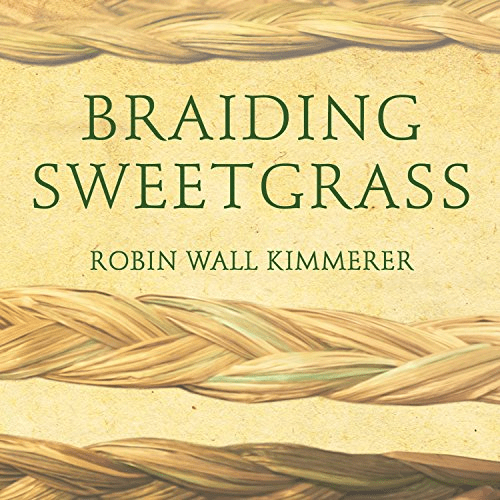
If ever there is a book that is worth rereading, it is Braiding Sweetgrass, by Robin Wall Kimmerer. I’m almost finished my third time through. Every read or listen yields new insights.
Yesterday I listened to a chapter called Witness to the Rain, about how raindrops come in different sizes depending on whether they drip from a maple leaf or a cedar twig, and how they fall with different rhythms and sounds. She says “maybe there is no such thing as rain; there are only rain drops, each with its own story.” Maybe we need different names for rain, just like some cultures and languages have different names for snow.
A little earlier in the book, she writes about Original Man, Nanabozho, and how he “was given a new responsibility: to learn the names of all the beings.” For a minute I thought this was very much like the Genesis story of Adam, but not quite. Adam named the animals from a place of authority, implying that Adam was above and apart from the rest of creation. But Nanabozho was tasked with learning the names of all the beings. They had names already, and he engaged with them, side-by-side in relationship.
I am happy it is snowing today. Tomorrow I’ll be able to explore fresh tracks, to see who of my neighbours passed by in the night, aside from the black cat who always keeps a good eye on the mice on my behalf. In summer, I take shots of plants and grasses with the Picture This app. I want to be able to greet my neighbours by name.
Perhaps, if I listen closely enough, the grass and flowers will tell me their names, their real names. Perhaps if I sit with this Place long enough, and often enough, I will remember and know these beings well, and become known by them. Perhaps, given time, I will become fully naturalized to this Land.
Robin Wall Kimmerer writes:
“Being naturalized to place means to live as if this is the land that feeds you, as if these are the streams from which you drink, that build your body and fill your spirit. To become naturalized is to know that your ancestors lie in this ground…. To become naturalized is to live as if your children’s future matters, to take care of the land as if our lives and the lives of all our relatives depend on it. Because they do.” (p. 214-215).
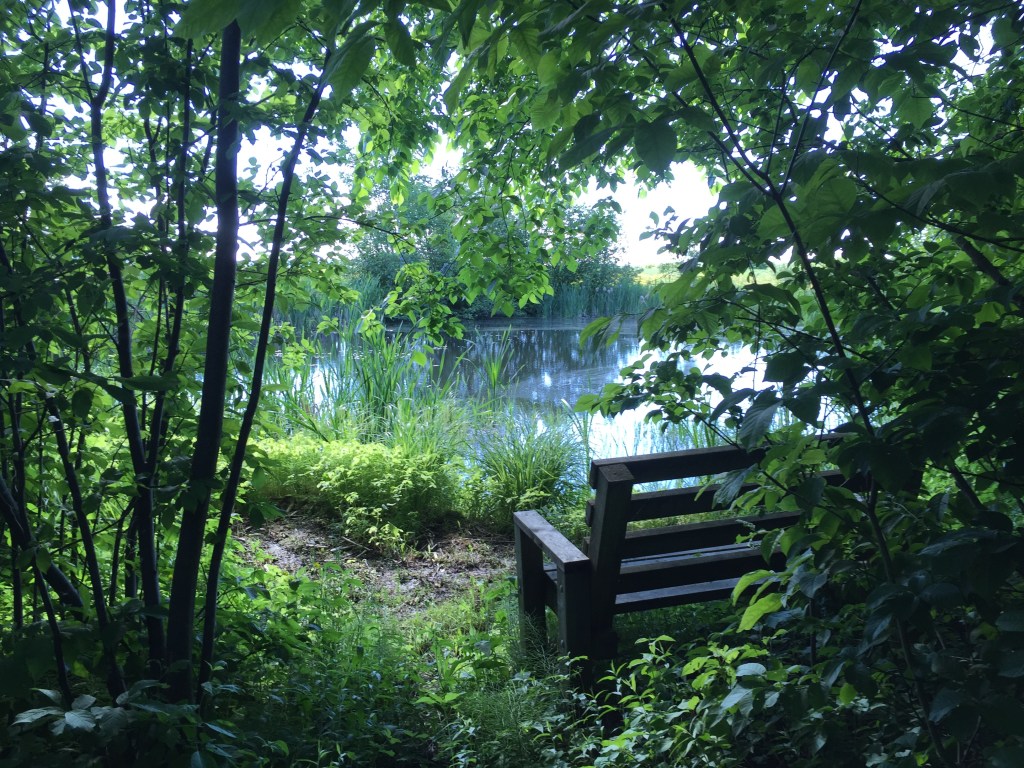
I took myself out to the Pond, to ask about its history, not so much the human history, of who walked this land in the time before my memory, but the place history — the history of water and soil — here. I walked the path to the other side, picking up and breaking fallen branches as I went. I found a few rocks that my husband might like, for the stone walls he has built and tended for many years.
As I puttered, I heard the words, “Life, death, life, death, life.” These are the same words I heard a month ago, as the leaves were falling into their next existence as soil, taking flight, flying on the breeze. This is the story of the Pond. “Life, death, life, death, life.”
I sat on my bench, and imagined myself decaying into the soil. I realized I was, in very real ways, already doing that, as my septic system decomposes and seeps, as it should, into the Earth, becoming part of the ecosystem. I become part of soil, as does any other animal in this place.
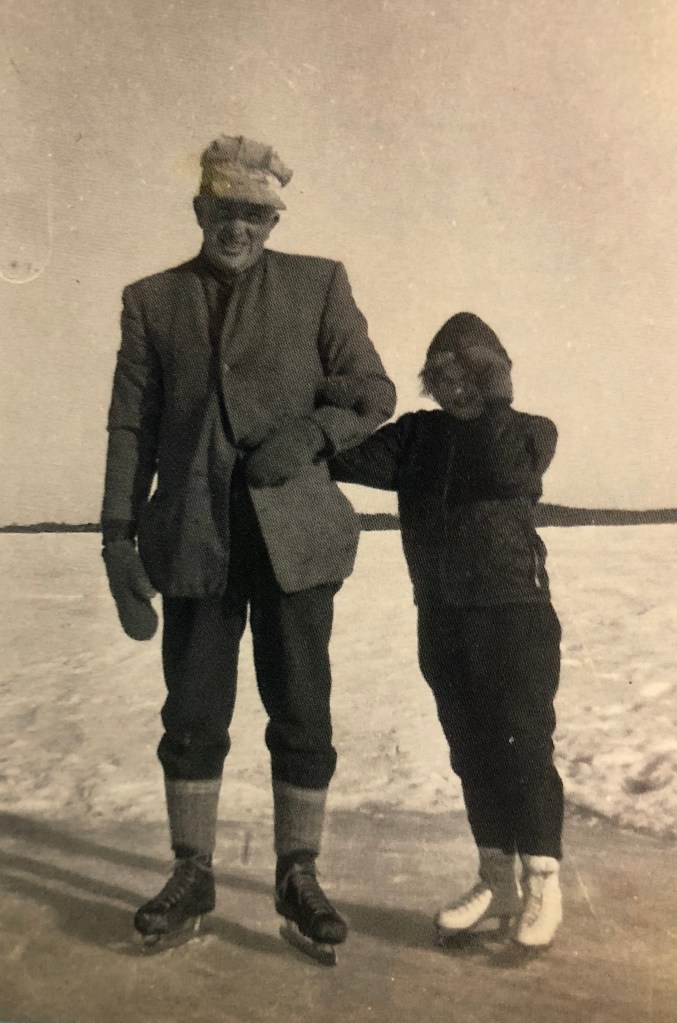
I felt into the changes we humans have made here. I remember what the pond was like when I was small, when I skated with my father. I remember a quiet corner of ice behind a row of alders, a safe place to skate and play, while hockey games claimed the main portion of the pond.
I remember how, over time, the pond filled with cattails, until there was only a muddy place in the middle, and how the cows would press through to get a drink in summer pasturing. I remember the bulldozer pushing it clear, and how awful the landscape looked for a season, until life renewed and greened. In recent years, my husband wades to pull cattails, praying for the help of Muskrat in this task, and chatting with Bittern. Bittern pretends to BE a cattail. If you stand still and weave your long neck back and forth like the reeds, no one can see you, don’t you know?
What was it like before my earliest memory? What did my Daddy do here as a boy? Did my grandfather make a rink? What boys skated here eighty years ago?
I belong here. I have grown in this soil, and contributed to this soil, for 66 years. I am born of the soil under my father’s finger nails. I spoke aloud, introducing myself as “Alice of this Land.” And the breeze immediately picked up, caressing my cheek, as the Spirit of the Place replied, “We know you. We know you.”
I belong to this place. I belong to this land. The land does not belong to me. I sat for some time, decaying into the soil, becoming. Decaying and Becoming. Feeling into the history of the Pond. Feeling the lives and deaths of frogs and ducklings, the dragonflies, the geese. Not human history, but the more than human history, and my part in the soil, my father’s breath in my nostrils, and the breath of the muskrat and groundhog.
I belong. I am part of this soil.
I puttered some more on my way back. I heard my sister’s voice as she walked past on the road, “Are you walking or wilding?” “Wilding,” I replied. It was a good day to be wild. One of many. I am part of this place. And the breeze kisses my face.


 Dream Bringer’s Studio